A Beginners Guide to Yin, Yang and the Five Elements in Chinese Medicine
What are yin and yang, the five elements, and Qi in Traditional Chinese Medicine? This simple introduction explains the foundations of TCM and how the meridian system connects emotional and physical health.


Traditional Chinese Medicine (TCM) is an ancient system of healing, thought to be between 2000-3000 years old. It encompasses a wide range of practices including diet, herbal medicine, exercise, acupressure, massage, and acupuncture. While it is a vast and complex medical tradition, many of its underlying ideas have quietly influenced Western complementary therapies. For that reason, I thought it would be interesting to explore some of its basic principles here.
However, before going any further I want to emphasise that I'm not a TCM practitioner and I'm only going to share the absolute basics of this fascinating medical system with you.
Yin and Yang – The Foundation of Chinese Medicine
The ancient Chinese developed their understanding of the body by observing the world around them and basing their philosophies on nature. What they noticed is that everything is based on the principle of yin and yang:
"The principle of yin and yang is the basis of the entire universe. It is the principle of everything in creation."
The Nei Ching
The easiest way to understand yin and yang is to imagine a mountain with the sun shining on one side of it. The sunny side is dry, light and warm and is considered yang. The other side, the shady, cool, dark, damp side is yin.
Although these sides of the mountain are very different, they are still two sides of the same mountain and you cannot have one without the other. You cannot have the concept of dark without light, cold without warmth, or damp without dryness.
In the same way, yin cannot exist without yang.
Everything in nature, and within our bodies, is described as either yin or yang. Yin qualities are soft, quiet, restful and often described as feminine, while yang qualities are hard, loud, active and masculine.
If you look at the illnesses we tend to develop, they often follow similar patterns. Some conditions come slowly, develop progressively and linger for a long time, while others begin suddenly, intensify quickly and pass just as fast. Similarly, in mental health we see conditions where a person becomes quiet and withdrawn, or loud, agitated and hysterical.
Too much of anything can lead to disease. Balance is key.
The Five Elements and the Cycles of Nature
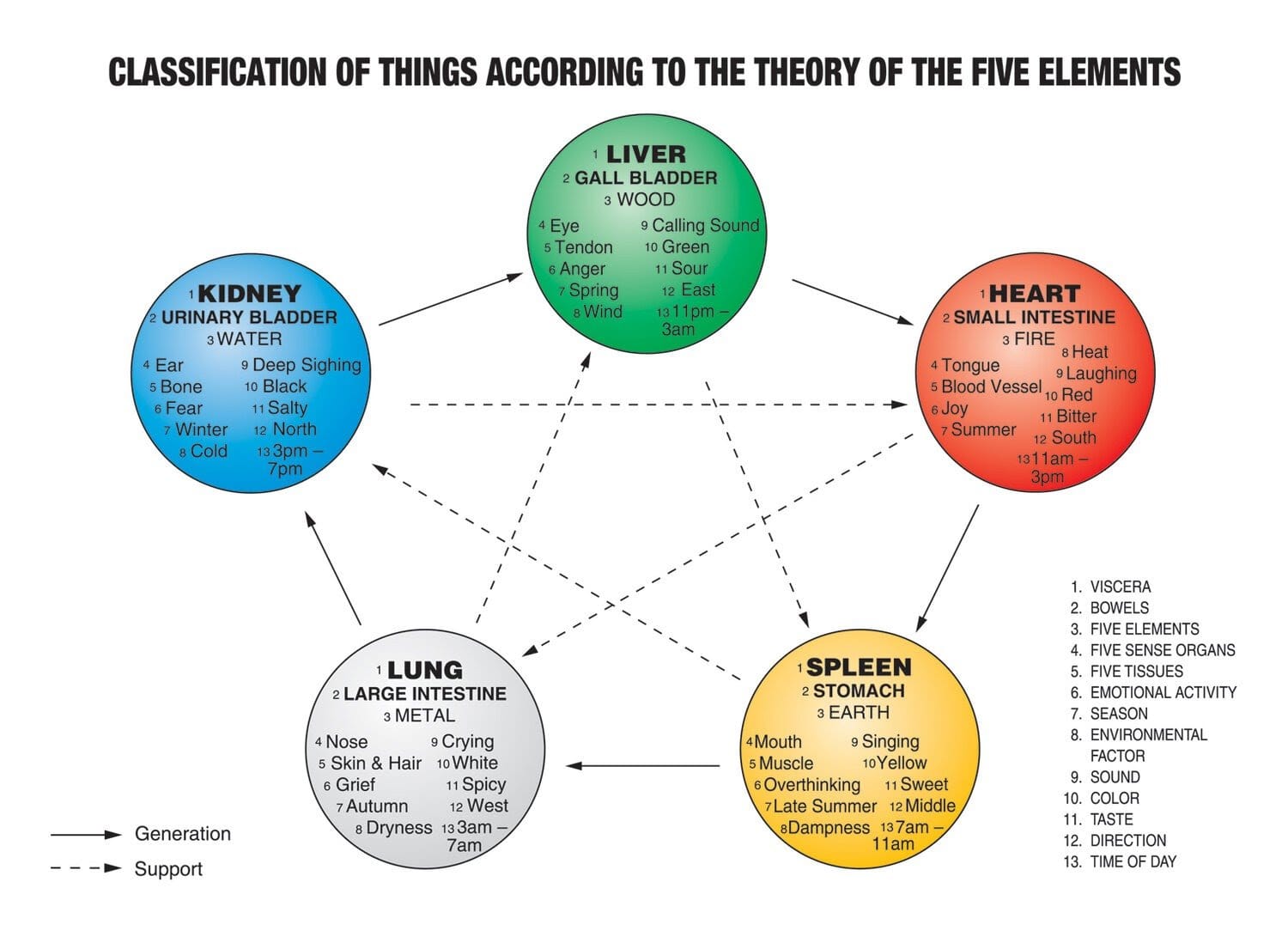
In addition to yin and yang, the ancient Chinese also learned from the cycles of nature. They observed how natural elements such as water, wood, fire, earth and metal interact with one another in either a creative or destructive cycle.
In the creative cycle, each element gives rise to the next. For example, water nourishes trees and allows wood to grow. Wood feeds fire, and the ash from fire returns nutrients to the earth. Within the earth, minerals form and give rise to metal, and metal in turn helps collect and channel water, which again nourishes the trees.
Alongside this nurturing cycle there is also a controlling or even destructive cycle, where each element moderates another. Water can extinguish fire, fire melts metal, metal cuts wood, wood can penetrate or disrupt the earth, and earth can absorb or contain water.
This is, of course, only a very simple way of describing what is quite a complex system!
The ancient Chinese applied these natural cycles to their understanding of human health, both physical and emotional. In their view, every person contains all five elements, yet one or two may be more prominent within the individual. These dominant elements are thought to shape aspects of our temperament, how we respond to life emotionally and physically, and even the patterns of illness to which we may be more susceptible.
For example, someone in whom the wood element is prominent may, when balanced, be decisive, purposeful, and inclined to take action. When this element becomes out of balance, however, the same qualities may express themselves as impatience, frustration, or anger.
At the same time, each element is associated with a pair of meridians through which Qi flows.
Qi and the Meridian System
In TCM there are five substances within the body: Qi, Blood, Jing, Shen and the Fluids.
I am only going to talk about Qi here because it is what is relevant to this blog and I do not want to overwhelm you with too much information.
Qi (also written as Chi, Ch'i or Ki) is our life force or life energy. It is responsible for all the processes that occur within our bodies and circulates through the body in one continuous channel. This channel is divided into fourteen sections, known as twelve major meridians and two extraordinary vessels.
As Ted Kaptchuk says in his book Chinese Medicine: The Web That Has No Weaver,
"Qi is responsible for the physical integrity of any entity; and for the changes that entity undergoes."
The twelve meridians work in pairs and are named after the bodily organs through which they flow. For example, we have a liver meridian, gallbladder meridian, heart meridian and so on.
These meridians either begin or end on the fingers and toes (which is why reflexology often works on the hands and feet), and they move Qi throughout the body. If there is a blockage in a meridian the Qi cannot flow freely and evenly, and disharmony, or disease, develops.
The pairs of meridians are also associated with one of the five elements and are either yin or yang.
Using Meridian Theory in Clinical Practice
Although we may not be trained in TCM, I have found over the years that having a basic understanding of the connection between the meridians and emotions gives me a wonderful starting point to help clients open up. I am continually amazed at how often this connection resonates.
For example, I once had an elderly male client with a chronic lung condition who was not very chatty. So I gently said to him, “This may sound strange, but in natural medicine we often connect the lungs to grief or loss. Does that mean anything to you?”
And then he began to open up about all the grief and loss he had been carrying inside him.
Bringing It All Together
When we step back and look at Chinese medicine in this way, we begin to see that it is really a system built on observation of nature and balance. Yin and yang describe the natural polarities that exist everywhere in life, while the five elements describe the cycles through which life moves and transforms.
Within the body, these patterns are reflected through the flow of Qi along the meridians, linking our physical health with our emotional and mental states.
Even a simple understanding of these ideas can offer a valuable framework for thinking about health. It reminds us that the body is not just a collection of organs and symptoms, but a dynamic system that is constantly responding to the world around us.
And perhaps most importantly, it reminds us that health is not about perfection. It is about balance.
If you are interested in understanding meridian therapy in more detail, you can have a look at my book The Complete Guide to Reflexology ->
If you enjoy reflecting on how physiology, lifestyle and therapeutics weave together in practice, you may enjoy continuing the conversation in my practitioner learning groups where we explore these themes together through discussion and shared clinical experience. You can find out more here ->
Please note: The reflections shared in this Practitioner’s Notebook are intended to encourage curiosity and thoughtful exploration among practitioners and students of natural and integrative health. They are not intended to replace structured professional training, clinical supervision, or independent clinical judgement. Practitioners remain responsible for applying appropriate professional standards and referring patients for medical care where appropriate.
Photo by 五玄土 ORIENTO / Unsplash