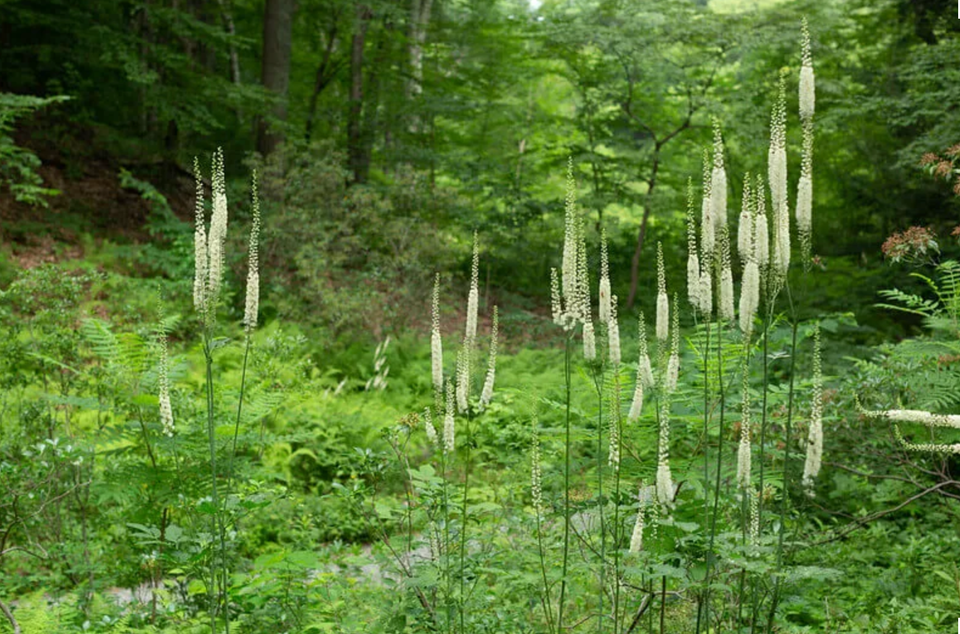
(Actaea racemosa / Cimicifuga racemosa / Squaw Root / Black Snake Root - Ranunculaceae family)
*** IMPORTANT: DO NOT USE IN PREGNANCY, LACTATION OR IF LIVER DISEASE ***
Black Cohosh is one of those herbs that has always made me a little wary. Perhaps it’s the name Black Snake Root, or perhaps it’s because its such a powerful herb. Whatever the reason, I am becoming more and more interested in it (perhaps because I'm menopausal!). So I thought I'd spend this blog getting to know it a bit more and untangling it on a deeper level.
First used by Indigenous Americans, this slow-acting herb knows how to go deep. It’s best known for supporting women through all kinds of hormonal ups and downs, but it’s just as powerful for easing pain, loosening tension, calming stress, and softening tight, cramped places. As Matthew Wood says:
“It is a remedy that both generates fluids and unbinds them, so that there is a better flow of fluids in the organism, especially the all-important cerebrospinal fluids surrounding the nerves. Hence it is indicated in nervousness, spasm, convulsions, menstrual cramps, back pain, and spinal injury.”
If we can remember that it “generates fluids and unbinds them,” it helps us recall a few key things about this herb: first, it’s really useful for absent or scanty periods (no fluids); second, a woman’s symptoms are often worse when she has no period and ease once her period starts, suggesting things are moving again; and third, it’s great for whiplash — think of all those stuck fluids in a tense, bound-up neck.
And this brings me to what I see as the key actions of Black Cohosh:
- It helps balance and regulate menstrual flow
- It’s especially useful when the menses are not flowing - menopause!
- It unbinds tight, tense muscles - it’s antispasmodic
- It relieves pain - think of the pain that comes from lack of flow, hormonal imbalance, and muscles locked in spasm.
As a homoeopathic remedy, Black cohosh is referred to as Cimicifuga racemosa. I'll write about its homoeopathic uses soon.
Black Cohosh for Hormonal Health
Black cohosh is probably most well known for its action on female hormones and its usefulness in menstrual issues including:
- Amenorrhoea (missing periods)
- Dysmenorrhoea (painful periods)
- Ovarian pain, polycystic ovaries
- Premenstrual syndrome (PMS)
- Menopause.
How it is thought to work:
In their book, Principles and Practice of Phytotherapy, Bone & Mills (2013) suggest that Black Cohosh works by modulating luteinising hormone (LH), not by mimicking oestrogen as other herbalists believe. This is perhaps why Black Cohosh has been shown to be a safe herb to use in women who have had oestrogen-dependent cancers or are on selective oestrogen-receptor modulators such as Tamoxifen.
LH is produced by the anterior pituitary gland and regulates ovulation as well as progesterone levels in women and testosterone levels in men. Too little or too much LH can disrupt fertility and menstruation. In balancing LH, Black Cohosh will help with fertility and menstrual issues.
Black cohosh in the reproductive years
Black Cohosh's antispasmodic, anti-inflammatory and analgesic actions also help with premenstrual symptoms that improve as soon as the flow begins. For example, brooding moods, abdominal cramps, spasmodic headaches or migraines. Phyllis Light says this herb is a specific for migraines that always come on 2-3 days before the period and clear once the period starts. And Blankespoor says it’s especially suited to:
“Dull, muscular pain in the back, pelvic region, and thighs, with a dragging pain in the uterus.”
🙇♀️
Picture this woman: Her periods are irregular and infrequent. She gets migraines 2–3 days before her period. Her neck and shoulders are tight, and she aches all over. She feels broody, low, like there’s a black cloud hanging over her. And then, when her period arrives - she feels better!
Black cohosh in menopause
In terms of menopause, Black Cohosh does not help as well as some other herbs do for hot flushes. Instead it works as an anti-inflammatory, antioxidant, and peripheral dilator. Studies suggest it acts on serotonin, dopamine, and opioid receptors rather than oestrogen receptors. That said, it does have effects similar to phytoestrogens in menopause, helping with symptoms like vaginal dryness, irritability and difficulty sleeping.
It is also a wonderful herb to use when perimenopausal or menopausal women suffer from muscular aches and pains or fibromyalgia during this particular stage of their life.
🙇♀️
Picture this menopausal woman: Her periods are infrequent. She is full of aches and pains, perhaps even has fibromyalgia. Everything feels dry! She is irritable. Depressed. Can’t sleep.
Black Cohosh for Spasms & Pain Relief
Richard Whelan has written a compelling blog on Black cohosh which I highly recommend if you're interested in this herb: Black Cohosh - Out of the Box. In it he writes:
"Black Cohosh was a revered healing herb, especially for pain. The pain of childbirth certainly, but also the pain of ageing, the pain of Winter’s cold seeping into the joints, the pain of loss in times when life could be brutally cut short. Black Cohosh was a revered herb because of its power to ease deep, real, immediate pain."
According to Bone and Mills, Black cohosh acts on opioid receptors and has notable anti-spasmodic, spasmolytic, anti-rheumatic and anti-inflammatory properties. Wood highlights that its action is particularly focused on muscular and nervous system pain related to tension and inflammation, rather than joint or bone pain. He finds it helpful when muscles are overly tight and tense, or conversely, too loose and lax. He also emphasises its use for pain in the belly of the muscle, especially where there’s a strong emotional or stress-related component. This suits fibromyalgia perfectly and Whelan writes that he has used it successfully in polymyalgia rheumatica.
Other pains that Black cohosh may ease include:
- Headaches
- Neck and shoulder tension (especially the trapezius region)
- Whiplash
- Post-spinal injury (for example after a fall)
- Tendinitis
- Pulled muscles
- Sciatica
- Fibromyalgia
- Post-viral pain
- Nerve pain after a snakebite – for lingering tingling or discomfort after recovery (Phyllis Light).
In addition to helping ease pain, Black cohosh can help relax spasms and is therefore not to be forgotten when working with:
- Spasmodic coughs such as Whooping cough or asthma. Phyllis Light recommends putting 5 drops in sweetened water because the sugar helps relax the cough and Margaret Grieve recommended it for the 'paroxyms of consumption'.
- Spasmodic movements such as chorea. Grieve refers to it as a specific in St. Vitus' Dance of children.
- Grieve also recommends very small doses for children's diarrhoea (perhaps due to erratic or spasmodic contractions of the intestines/increased peristalsis?).
The "Black cohosh person"
cold and empty, all knotted up and stuck
In homoeopathy we always talk about the person who needs the remedy and we try to draw a picture of that person - for example, a woman needing homoeopathic Sepia is referred to as a 'Sepia woman' and on hearing these words every homoeopath will have the picture of a tired, worn-out woman in their mind. I think the same can be for herbs.
The image I get in my mind of a Black cohosh person will be someone who is a little bit cold and empty, all knotted up and stuck in life, unable to move forward. Here's where I get this image from:
- Blankespoor notes that Michael Moore used it for what he described as “purple-pain” - cold, congestive, dull aches in people who feel cold, clammy, and feeble. Whelan also notes that he finds it works better in people who tend to have a cooler constitution and notes its characteristic hallmarks are "depletion, constriction and pain".
- Matthew Wood recommends it when someone is feeling stuck, "scrunched up in the mind", as if their soul is captured. He says it helps with brooding, melancholic individuals who need to untangle themselves from another person or perhaps stand up to a bully.
- The herb is traditionally referred to as black snakeroot and is used to help someone 'shed their skin' and move on. It makes sense that it is so often indicated in menopause when a woman may be clinging to the past, struggling to move forward or “shed her skin”, but we must be careful to not only use it as a woman's remedy because anyone can be stuck and tangled up in life.
- Whelan uses Black cohosh to help lift people's moods and recommends it for pain when accompanied by depression or inertia in a person who is of a cooler constitution. He writes:
If you take some Black Cohosh yourself with a quiet mind you will surely feel how warming and stimulating it is – it moves things. These are potent properties that especially help people whose ‘energy’ gets stuck or stagnant in the joints, the nerves, the uterus, the ovaries, or the mind.
If you enjoy reflecting on how physiology, lifestyle and therapeutics weave together in practice, you may enjoy continuing the conversation in my practitioner learning groups where we explore these themes together through discussion and shared clinical experience. You can find out more here ->
Important Notes
- Best used with other herbs, not alone
- Use low doses only (but read my discussion on dosage below and let me know your experiences)
- High doses can cause frontal headaches, nausea, skin tingling (like ants crawling!)
- Takes time - 3 to 6 months of consistent, small dosing (1–3 drops) given weekdays with a rest on weekends, or two weeks on two weeks off
- Don’t use for longer than 6 months
- Avoid in liver disease, pregnancy, or lactation. However it is used during childbirth/labour.
Dosage
Dosage of herbs is something I always seem to struggle with. Being a homoeopath at heart I prefer to use drop doses of herbs, with the intention of gently stimulating the body to do what it was created to do. So far in my personal experience, I have only used drop doses of Black cohosh and found it to work beautifully, but slowly, for amenorrhoea, dysmenorrhoea, menopause and chronic rheumatic/myalgic pains. I have also only ever given it as part of a blend, never by itself.
However, Whelan's blog has got me thinking! In his blog he refers to herbal writings from the 1800s where Black cohosh was used frequently in high doses for acute pain relief, quoting from Felter and Lloyds King’s Dispensatory from 1898:
"Black cohosh....to be given in doses of 10 drops every 2 hours, gradually increasing to 60 drops, or until its action on the brain is observed, which action must be kept up for several days; it almost always removes the disease permanently, especially if it is a first attack."
and Whelan writes about his own experiences, saying:
"If the patient is suffering with acute pain in the nerves or the joints and you give Black Cohosh in increasing doses up to the point that a headache is noticeable and then at that point back down to the previous level, there is a rapid, and often quite remarkable, clinical response...Once that odd, piercing frontal headache happens, you know you have reached the threshold, you tell the patient to ease back to the previous level but not to stop, then, watch what happens to their pain. You must be seeing the patient within a week at most as this is a short term treatment only...."
Wood also mentions that John Scudder used 1-2 teaspoons of tincture every 3 hours for pain until a headache developed. Other side effects of high doses are nausea and prostration.
I am curious to try this!!! If you, dear reader, have any experience here please let me know in the comments below 😄
Blends
When I explore a herb, it feels a bit like exploring a new wine. I add a drop to a little water, swirl it around the glass, close my eyes, and breathe it in.
The aroma of Black cohosh is 'dark' - if that makes sense. Rich, earthy, a little sweet and slightly smoky. It reminds me of dark treacle or molasses. The taste carries that smokiness too. There's a slight touch of sweetness to begin but that is soon overcome by a definite bitterness, and as the flavour unfolds, the inside of my mouth feels drawn in and dry and I'm left with a lingering sense of smoke in my mouth. And the feeling it gives? When I close my eyes, I see a forest floor — dark, rich, damp with decaying leaves. Brown, black, warm, and alive.
Here are a few formulas from my favourite writers, and if you're a herbalist I would love to hear your experiences with this herb - the more we share, the more we learn 😀:
For Hormone Balance
Phyliss Light (use for 3–6 months weekdays only, 1–3 drops, 1–3x/day):
- Vitex (3 parts)
- Black Cohosh (2 parts)
- Wild Yam (Dioscorea) (1 part)
Juliet Blankespoor (use 3ml twice daily):
- Vitex (3 parts)
- Black Cohosh (1 part)
- Dandelion root (1 part)
- Vervain (1 part)
For Musculoskeletal Pain (arthritis, fibromyalgia, tendinitis)
Juliet Blankespoor (acute: up to 4ml every few hours for 2–3 days / chronic: 2–4ml up to 3x/day):
- Black Cohosh (1 part)
- Viburnum (1.5 parts)
- Meadowsweet (1 part)
- Skullcap (0.5 part)
- Willow (0.5 part)
Phyliss Light (fibromyalgia): 3 drops, 3x/day:
- Black Cohosh (1 part)
- Valerian (1 part)
- Passiflora (1 part)
Phyliss Light (after spinal injury):
- Black Cohosh with St John’s Wort or Boneset (equal parts, 1–3 drops, 2–3x/day)
Matthew Wood (for whiplash):
- Black Cohosh with Lobelia or Passionflower (3 drops in the morning, for 6–12 months)
Phyliss Light (nerve pain post-snakebite):
- Black Cohosh with Valerian (3 drops, 3x/day)
Wood & Light (spasmodic coughs):
- Black Cohosh with Red Clover
Please note: The reflections shared in this Practitioner’s Notebook are intended to encourage curiosity and thoughtful exploration among practitioners and students of natural and integrative health. They are not intended to replace structured professional training, clinical supervision, or independent clinical judgement. Practitioners remain responsible for applying appropriate professional standards and referring patients for medical care where appropriate.
Bibliography:
Blankespoor, J. (2022). The Healing Garden. Harper Collins Publishers LLC.
Bone, K. (2021). Functional Herbal Therapy: A Modern Paradigm for Clinicians. Aeon Books Ltd.
Bone, K., & Mills, S. (2013). Principles and practice of phytotherapy: Modern herbal medicine (2nd ed.). Churchill Livingstone.
Grieve, M. (1982). A modern herbal (C. F. Leyel, Ed.). Penguin Books. (Original work published 1931)
Light, P. & Wood, M. (n.d.). Herb Talk: Black Cohosh. Matthew Wood Institute of Herbalism. https://matthewwoodinstituteofherbalism.com/
Wood, M. (2008). The Earthwise Herbal Volume 1, A Complete Guide to Old World Medicinal Plants. North Atlantic Books.
Whelan, R. (2013). Black Cohosh - Out of the Box. Online: https://www.rjwhelan.co.nz/articles/black_cohosh_out_of_the_box.html